
According to IDC, 92% of high-performing small and medium-sized businesses have adopted ERP to
According to IDC, 92% of high-performing small and medium-sized businesses have adopted ERP to outperform their competitors.
Thus, needless to say, the role of ERP companies is immense in streamlining business processes such as inventory, HR, supply chain, accounting, and finance. Today, SMBs can effortlessly achieve enterprise-grade capabilities through real-time insights, centralised dashboards, and automation.
So, in this blog, we will delve into the top ERP companies in 2026 to help you choose the right vendor for your business for sustainable growth and scalability. We ensure you can make better-informed decisions and get going without deliberation.
An ERP company designs, implements, customises, and supports Enterprise Resource Planning (ERP) software that helps businesses run their core operations from one integrated system. In other words, they build modules that align with a business’s workflow to deliver end-to-end solutions from a single platform.
In the present era, ERP software for businesses is a fundamental tool for consistent, efficient, and scalable long-term growth. Most organisations use ERP to eliminate data silos and improve accuracy, enabling faster ROI.
However, let’s not forget that ERP companies or vendors differ from implementation partners. Odoo, SAP, Microsoft 365, etc., are publishers that build technology stacks and are responsible for updates.
On the other hand, implementation partners analyse business goals and configure the software accordingly. Additionally, ERP consulting companies provide ongoing support and maintenance.
The best ERP companies in 2026 deliver:
ERP companies provide the critical technology that unifies business functions into a single, integrated system. Most ERP platforms include core capabilities designed to enhance operational efficiency, streamline decision-making, and simplify daily workflows.
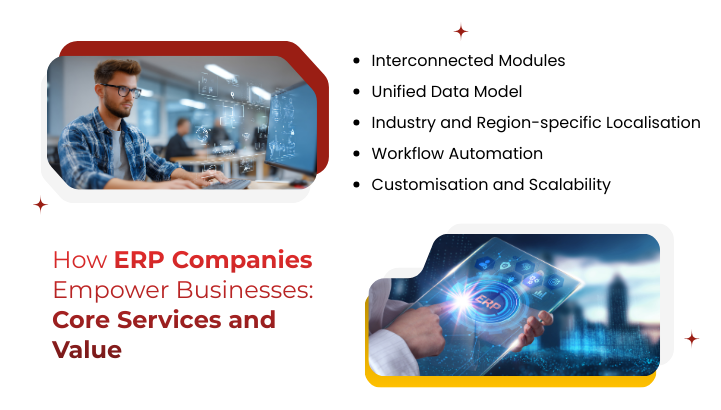
| Core Capabilities | Business Benefits |
| Interconnected modules | Reduces data silos and increases operational efficiency. |
| Unified data model | Eliminates duplicate data and inconsistencies. |
| Industry and region-specific localisation | Supports tax compliance and removes bottlenecks. |
| Workflow automation | Automates repetitive tasks to accelerate time-to-market. |
| Customisation and scalability | Adapts to an expanding marketplace for effortless growth. |
With a unified software suite, an ERP software helps in interconnecting modules like finance, inventory, sales, operations, HR, and supply chain. This ensures all departments operate within the same environment, reducing reliance on disconnected tools, minimising duplicate data, and maintaining smooth operational workflows.
Core functions usually include:
ERP companies build systems that centralise operational data, eliminating inconsistencies and repeated data entry. By maintaining a unified data model, master records and transactions stay consistent across all business processes.
Key benefits include:
Many ERP solution providers deliver tailored configurations to meet industry-specific requirements, supporting sectors such as manufacturing, retail, wholesale, distribution, and service-based businesses. They also accommodate regional needs, including local taxes, compliance rules, and reporting standards, enabling smooth operations across markets.
This typically includes:
ERP platforms include preconfigured workflows that automate routine tasks, simplify approval processes, and enhance planning. Integrated dashboards, reports, and analytics give leaders real-time insights, enabling faster, data-driven decision-making.
Common benefits include:
ERP companies enable businesses to extend and customise their systems using additional modules, APIs, and app marketplaces. This flexibility allows companies to tailor the platform to their unique workflows and seamlessly integrate other tools within their technology ecosystem.
Standard extension options include:
Today’s ERP ecosystem brings together legacy enterprise vendors, modern cloud innovators, and specialised industry providers. The following section highlights leading ERP software companies and their flagship offerings.
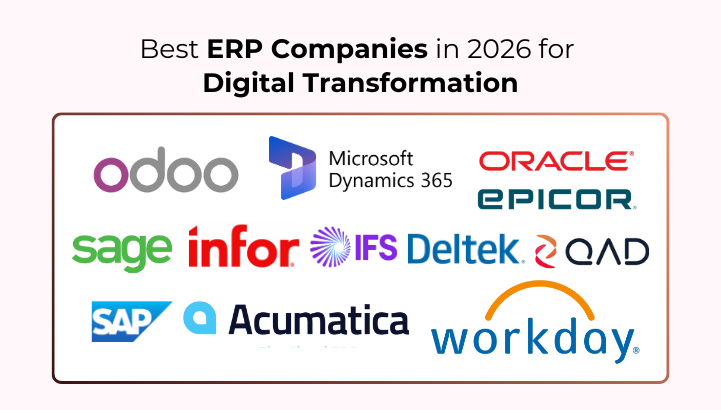
| ERP Platform | Industry Specialisation | Key Features | Deployment Model |
| Odoo | Manufacturing, Retail, eCommerce, Services, Distribution, SMEs | Modular apps, CRM, Accounting, Inventory, Manufacturing, eCommerce, Customisation-friendly | Cloud, On-premise, Hybrid |
| SAP | Large Enterprises, Manufacturing, Utilities, Finance, Logistics | End-to-end ERP, Advanced analytics, Supply chain management, Compliance, AI & automation | Cloud, On-premise, Hybrid |
| Oracle | Enterprises, Finance, HR, Supply Chain, Asset-intensive industries | Financials, HCM, SCM, Strong reporting, Enterprise security |
Cloud, On-premise, Hybrid |
| Microsoft Dynamics 365 | SMBs & Enterprises, Retail, Manufacturing, Services | ERP + CRM integration, Power BI, Automation, Microsoft ecosystem integration | Cloud, Hybrid |
| Sage | Accounting-focused SMBs, Construction, Manufacturing | Financial management, Payroll, Compliance, Simple ERP workflows | Cloud, On-premise |
| Infor | Manufacturing, Healthcare, Distribution, Fashion, Food & Beverage | Industry-specific ERP, Supply chain, CloudSuite, Analytics | Cloud, On-premise |
| Epicor | Manufacturing, Distribution, Retail, Automotive | Production management, Inventory, MES, Industry-focused workflows | Cloud, On-premise, Hybrid |
| Acumatica | SMBs, Distribution, Construction, Manufacturing | Cloud-native ERP, Flexible licensing, Financials, Project accounting | Cloud |
| IFS / QAD / Deltek | Asset-intensive industries, Manufacturing, Defence, Engineering, Services | Project-centric ERP, Asset management, Compliance, Industry depth | Cloud, On-premise, Hybrid |
| Workday | Enterprises, HR-centric organisations, Education, Healthcare | HCM, Financial management, Workforce analytics, Cloud-native design | Cloud |
Among the top ERP companies 2026, Odoo is one of the most preferred business platforms for small and medium-sized organisations due to its immense flexibility and scalability. You can adopt Odoo at any stage of your business and let it expand as you grow.
Its modular architecture, customisation features, and industry-specific characteristics effortlessly integrate with manufacturing, finance, sales, inventory, supply chain, and other services.
SAP delivers enterprise-level ERP solutions built to manage global operations, complex supply chains, and multi-company financial structures. Its core platforms support advanced manufacturing, regulatory compliance, and enterprise reporting, making SAP a preferred choice for large organisations that demand scalability, control, and governance.
Oracle is favoured explicitly for its cloud-first approach. This ERP company is ideal for medium- to large-sized enterprises, as it supports business processes across CRM, finance, commerce, and supply chain, providing broad-spectrum coverage.
Organisations looking for a centralised environment should consider Oracle Cloud and NetSuite, two of the best ERP vendors for enterprises.
For companies that rely on the Microsoft ecosystem, the Dynamics 365 suite seamlessly integrates with core business operations, including sales, finance, supply chain, and more. Microsoft Dynamics 365 offers extensive coverage and flexible deployment options.
Sage provides reliable ERP and accounting solutions designed primarily for small and mid-sized businesses. As one of the popular ERP companies in 2026, its platforms focus on financial management, payroll, compliance, and operational control, helping organisations streamline core processes, maintain regulatory accuracy, and gain clear visibility into business performance through flexible cloud and on-premise options.
Infor is specifically designed for manufacturing, service, and distribution businesses. It is highly favoured for complex production and logistics workflows, offering in-depth real-time insights and visibility. Infor is a powerful solution for industrial organisations.
Among other ERP software providers, Epicor is ideal for the industrial sector that requires greater workflow control and shop-floor visibility. From manufacturing to retail, Epicor is a specialised ERP platform that supports operational efficiency.
Flexibility, scalability, and comprehensive coverage are the key drivers behind Acumatica adoption. Acumatica is perfect for medium-sized organisations, offering a superior user experience and sophisticated features.
IFS, QAD, and Deltek offer ERP solutions tailored to industry-specific needs, supporting complex manufacturing, engineering, project-driven, and supply chain operations. Their specialised workflows make them ideal for organisations with advanced operational requirements or unique industry processes.
Among cloud ERP companies, Workday is perfect for HR-centric organisations and advanced financial operations. Therefore, most large enterprises rely on Workday for payroll, workforce, and finance applications.
Let’s not forget that the success of an ERP company depends on how well it aligns with your business needs and workflow structure. A well-planned strategy can minimise threats and boost efficiency for long-term growth.
As business sizes vary, workflow complexities also differ. Simply put, small organisations will have easy implementations and uncomplicated operations. On the other hand, large enterprises have intricate processes across multiple departments and higher transaction volumes.
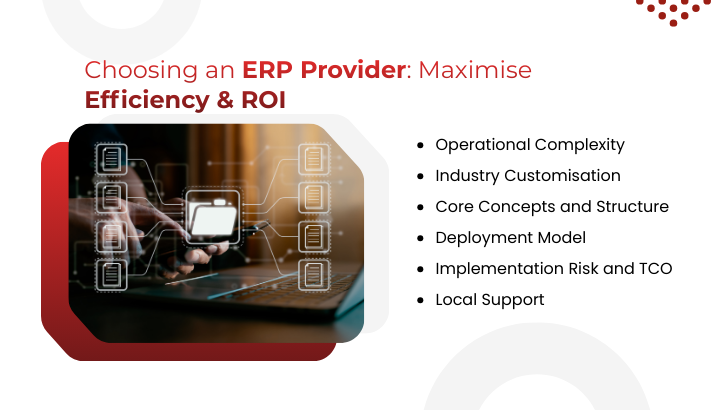
Therefore, you need an ERP company that eliminates unwanted bottlenecks.
Different industries require specialised ERP modules. Selecting a system tailored to your operational model ensures smooth processes without costly add-ons or workarounds.
An ERP should seamlessly integrate with your business-critical tools, including eCommerce platforms, communication apps, analytics systems, and external services. Established ecosystems and ready-made connectors minimise the need for custom development and speed up deployment.
ERP implementation companies provide cloud, on-premise, and hybrid deployment solutions. The former facilitates straightforward updates, while on-premises deployment offers greater control. However, a hybrid environment supports boosted transitional flexibility.
Beyond the software license, a long-term ERP investment involves configuration, data migration, user training, and ongoing system enhancements. Considering these elements upfront ensures smoother adoption and more successful project outcomes.
Implementation partners play a critical role in system configuration, user training, and ongoing support. For Australian organisations, local expertise ensures the ERP aligns with regional regulations, business practices, and operational needs.
Successful implementations begin with well-defined requirements, structured demonstrations, and pilot programs that validate real-world workflows before full rollout. This process ensures the system fits operational needs and supports effective change management.
For Australian organisations planning their next steps, Envertis provides expert support with scoping, solution demonstrations, and tailored recommendations, helping businesses move confidently from research to a smooth, well-executed ERP implementation.

Odoo is ideal for small and medium-sized businesses (SMBs) due to its modular architecture and enormous flexibility. However, SAP works better for medium- to large-sized enterprises due to its scalability and compliance capabilities. The choice depends mostly on business size and complexity.
The top 5 ERP companies for SMEs are Microsoft Dynamics 365, Oracle NetSuite, Odoo, SAP, and Acumatica.
Absolutely. An ERP company can help increase ROI (Return on Investment) directly and indirectly, but this depends on how effectively the ERP is implemented and used.
Get free consultation and let us know your project idea to turn it into an amazing digital product.

Se 506, 8 Help Street, Chatswood, NSW 2067
324 Queen Street, Brisbane, QLD 4000
171 Collins Street, Melbourne, VIC 3000