
Businesses are beginning to recognise that innovative methods to deliver superior service to customers have
Businesses are beginning to recognise that innovative methods to deliver superior service to customers have growing importance. With an increasingly competitive marketplace and a shift in customer expectations about how they want to work with organisations. Enterprises must integrate their CRM solutions, like HubSpot, with ERP Solutions like Odoo as one holistic approach. Doing so will enable organisations to rid themselves of the information silos, enhance productivity.
It also enables them to make fast, smart, informed, data-driven decisions in their Sales, Marketing, and Operations departments. Recent reports from the industry reveal the importance of these integrated systems, as over 70% of businesses are dependent on these types of integrated systems to deliver outstanding customer experiences.
The integration of Odoo and HubSpot allows organisations to develop this kind of integrated system. Any business process, by integrating Odoo with HubSpot, can synchronise its data in real time, minimise any potential for error in the manual processes.
This blog covers the ultimate CRM & ERP integration strategies and approaches for businesses of all sizes.
The 21st century has challenged business with disconnected Silo data sources that provide inefficient and misplaced information between Sales, Marketing, and Operations. As a result, these organisations are duplicating efforts, holding on to inconsistent data, and losing out on potential revenue from customers. A common challenge for many businesses is to utilise standalone platforms as a way to support these organisational goals.
By integrating HubSpot – Odoo ERP Systems, the significance of HubSpot integration in Australia is to eradicate these Silo data sources, thereby allowing real-time access to important customer/business-related information, while synchronising HubSpot and Odoo together to perform and deliver accurate and up-to-date data across Sales and Operations without the ongoing need for human intervention or additional reconciliation work.
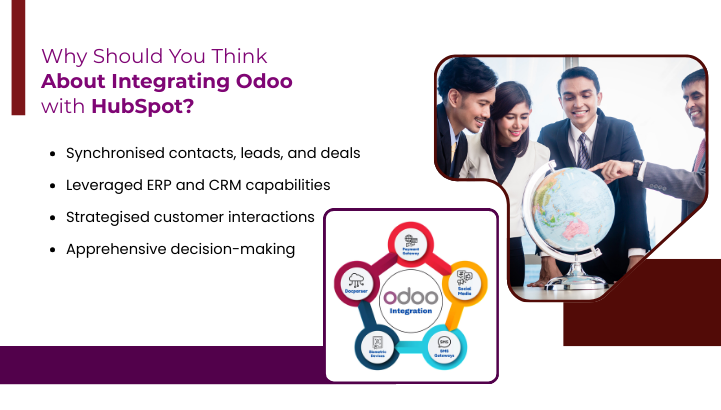
Key benefits of leveraging Odoo HubSpot integration:
1. To ensure that your teams are working with the most recent data, synchronise contacts, leads, deals, and activities across platforms. Working with inconsistent datasets is less frustrating because of this integration.
2. Leverage Odoo and HubSpot’s combined capabilities to automate repetitive operations like lead assignment, follow-ups, and marketing triggers.
3. Teams can zero in on strategy and customer interaction instead of data input when manual procedures are eliminated through linked platforms.
4. A thorough understanding of client interactions, including inventory, orders, and financial data, can be obtained by combining the features of HubSpot with Odoo.
The difficulties of disparate workflows are addressed by the Odoo-HubSpot CRM interface. Whether you like Odoo’s all-in-one ERP features or HubSpot’s inbound marketing expertise, the right connection creates the conditions for careful decision-making.
Data becomes dispersed throughout sales and marketing when Odoo ERP and HubSpot CRM operate independently, leading to inefficiencies and uneven customer experiences.
The following facts demonstrate how your business performance is directly harmed by unconnected systems –
When customer data is kept in two separate systems, it becomes inconsistent. According to the Harvard Business Review, only over 2% of CEOs claim to have correct data.
According to industry statistics, businesses believe that 30% of their data is erroneous, which has an impact on marketing efficacy. Teams never have a complete view of their customers since HubSpot stores marketing interactions, and Odoo holds operational data.
Tracking the whole lead path or locating bottlenecks is challenging with disconnected systems. Businesses that are adept at lead nurturing produce 50% more leads that are ready for sales at a 33% reduced cost. High-quality nurturing procedures are just not possible without a cohesive record of encounters.
A lack of sales data prevents marketing teams from developing tailored messaging and improving campaigns. Approximately 70% of all marketing leads will not convert due to ineffective follow-ups and a lack of coherent strategy between marketing and sales departments, with no data analytics connectivity or centralisation.
When two platforms are disconnected, brand language, offerings, and communication style change. Better channel integration enhances the purchasing experience, according to more than 45% of customers. End-user experience latency from fragmented systems right away.
Building an accurate, consistent, and quantifiable customer journey is hampered by keeping Odoo and HubSpot in separate silos. Moreover, Odoo Hubspot integration helps your revenue teams work together, enhances the quality of your data, and makes it possible for automation to move leads through the funnel much more quickly.
By contrasting Odoo with HubSpot CRM, one can better comprehend each platform’s distinct advantages and ascertain whether integration is required for cohesive sales and marketing processes.
HubSpot is a stand-alone CRM software that is well-known for its user-friendly interface, robust marketing automation, email sequences, and more. Additionally, it can help your business with lead scoring, automation of marketing, email marketing, and content engagement.
Odoo CRM stands out by embedding sales processes within a comprehensive ERP ecosystem. This eliminates silos, enabling Australian businesses to manage the entire customer lifecycle, from lead capture to invoicing and fulfilment in a single platform.
Go with HubSpot if your priority is rapid GTM: campaigns, automation, sequences, CMS, and a happy sales team out of the box. Choose Odoo if your operations drive value: real-time stock, accounting, GST/e-invoice, multi-company/warehouse, approvals, and manufacturing on a unified ERP.
Getting Ready for Odoo HubSpot integration in Australia is like setting objectives, evaluating the quality of the data, and figuring out how important procedures should function in both systems. The following are the first steps of integrating HubSpot CRM.
Do you wish to raise lead generation by a certain percentage? It’s time to free up your team’s efforts by automating expensive marketing operations. Understand further about your clients to personalise your sales strategy and establish objectives to ensure the integration meets your pressing demands.
Let’s say, you should give top priority to features that enhance lead gathering forms, automate lead scoring, and nurture leads with personalised email sequences if your main objective is to produce more qualified leads.
Make a note of your present Odoo and HubSpot data environment, assessing the consistency and correctness of your data. Missing fields and redundant, out-of-date data might cause integration problems and lower automation’s efficacy.
Think about how much data you now handle and make plans for future growth. Indicate which data points, such as contacts, online activity, sales interactions, or prior marketing campaigns, you want to sync and map during integration.
Transferring historical data from one system to another could be crucial, given your existing data setup. Customer information, sales data, and marketing campaign performance data may be examples of this.
Difficulty of data migration, which could differ depending on format and amount. Before syncing, data has to be cleaned to ensure correctness and integrity on both platforms.
Different user roles within your organisation may require access to certain data and functions as a result of integration.
To safeguard data and stop illegal usage, clearly define user roles and privileges in both HubSpot and Odoo.
Odoo HubSpot integration in Australia is, without a doubt, it is among the best, most intelligent, and real-time syncs between the two platforms. It facilitates smooth teamwork, appropriate campaign attribution, and centralised customer administration.
It’s important to comprehend Odoo and HubSpot’s major advantages when integrating them. The Odoo-HubSpot connection is a popular option for businesses seeking the best of both worlds because both systems handle CRM demands but have different functions and business strategies.
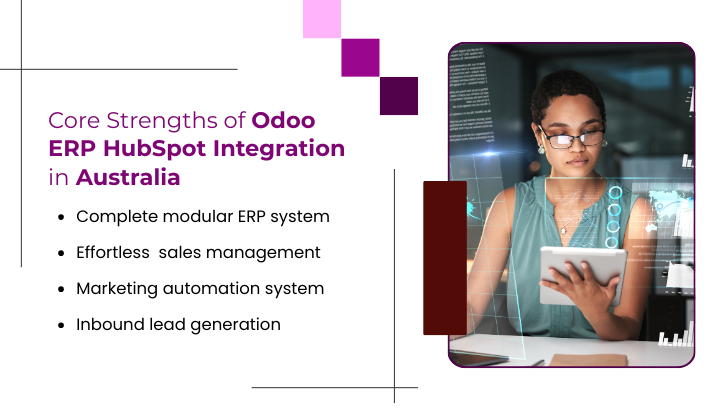
Consider the following core strengths to get the best of both worlds:
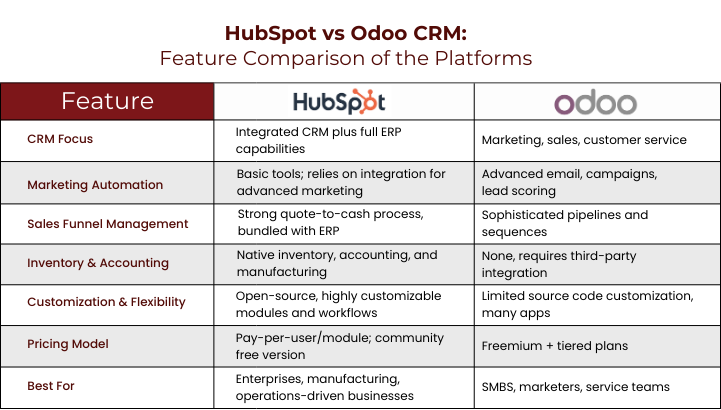
HubSpot is a great option for small to medium-sized organisations that want to rapidly increase their marketing activities without having to incur significant IT expense because of its well-received smart and simple interface. Prices range from free tiers to business-level solutions with cutting-edge capabilities.
For businesses looking for a fully integrated ERP solution that goes beyond CRM, Odoo’s flexible per-app pricing provides affordability and flexibility. Odoo is a good choice for manufacturing, distribution, and multi-department businesses since it enables greater customisation but may have a longer learning curve.
Organisations contemplating the Odoo-HubSpot CRM connection frequently base their choice on whether marketing-led growth or operational excellence is more important. By providing a simple data flow and coordinated sales and marketing activities, integrating both can be revolutionary.
Although integration makes data flow between HubSpot CRM and Odoo ERP more efficient, however, there are certain limitations to take into account:
Your data complexity, customisation demands, security requirements, and long-term system objectives will determine which Odoo-Hubspot integration connectivity technique is best for you. The following approaches will give you an overview of what will best suit your needs –
Key CRM and marketing records can be synchronised with the majority of integration options, including:
By ensuring that Odoo and HubSpot represent the same customer data, two-way collaboration avoids inconsistencies and tedious re-entry.
Most configurations include the following actions, regardless of whether they’re deploying HubSpot Data Sync or a custom integration:
This app was developed by the HubSpot team. Although HubSpot Data Sync is an independent HubSpot application, it does allow Odoo connections. Through the use of APIs, this application establishes a link between Odoo and HubSpot for straightforward data sharing.
It allows for automated synchronisation by mapping relevant data fields across the two platforms. Always remember that you can only utilise the app if your HubSpot subscription is up to date. Depending on your membership package, different features are available.
As certified specialists, Odoo partners create precise and secure connections between Odoo and various platforms, such as HubSpot. Furthermore, you could get customised integration based on Odoo’s framework with continuous support by working with an Odoo partner.
Envertis offers extensive experience connecting Odoo with CRM programmes like HubSpot as a licensed Odoo partner in Australia.
No. Although Odoo does not come with a built-in HubSpot interface, connectivity is possible via third-party connectors, customised API-based solutions, or HubSpot Data Sync.
Indeed. During the switch, many businesses use both systems, synchronising important CRM data while progressively moving lead or marketing management into Odoo if necessary.
Costs differ depending on the approach: personalised integrations cost upfront development but offer more freedom and fewer long-term restrictions, whereas HubSpot Data Sync requires a subscription account.
Summing Up
Odoo HubSpot integration can provide you with endless possibilities for your organisation. With your marketing and sales departments having a full view of your customers’ journey when data is pulled from multiple sources into one central location, your employees will spend less time on data entry and can spend more time focusing on high-value work, as automated tasks allow employees to use their time more productively.
Last but not least, you should know that you aren’t obligated to navigate this transition by yourself. However, if you have trouble handling complex integration, contact a reputable firm or experienced partner like Envertis to support you. They’ll help you achieve maximum value for your investment and minimise disruptions to business operations while enabling successful deployments of integrations based on their own experience.

Get free consultation and let us know your project idea to turn it into an amazing digital product.

Se 506, 8 Help Street, Chatswood, NSW 2067
324 Queen Street, Brisbane, QLD 4000
171 Collins Street, Melbourne, VIC 3000