
Odoo CRM empowers growing businesses to create structured, scalable sales systems. Learn how Odoo CRM
Odoo CRM empowers growing businesses to create structured, scalable sales systems. Learn how Odoo CRM Australia strategies transform pipelines into predictable revenue.
Here’s a number that should stop you in your tracks: companies that implement a CRM effectively see up to a 29% increase in sales revenue — yet most businesses using Odoo CRM are running it like a glorified spreadsheet.
If you’re a Sales Manager, CEO, or Business Owner in manufacturing, distribution, retail, or services, you already know the pain. Your team has the tool. But leads are slipping through the cracks, follow-ups are inconsistent, and your pipeline report doesn’t reflect reality.
In this blog, you’ll learn exactly how to configure and use Odoo CRM to build a sales system — not just software. You’ll walk away with actionable frameworks to optimise your pipeline stages, automate follow-ups, score leads intelligently, and generate reports that actually drive decisions.
Let’s get into what separates the teams that win with Odoo CRM from those that just log activity.
The number one mistake businesses make with Odoo CRM solutions is treating implementation as an IT project rather than a sales strategy project. You get the system set up, import your contacts, and hand it to the team, then wonder why adoption is low three months later.
The root cause is almost always a mismatch between Odoo’s pipeline stages and your actual sales process. If your CRM stages say ‘New’, ‘In Progress’, and ‘Won’, you’re tracking hope, not process. Meaningful stages reflect specific actions or commitments, such as ‘Needs Analysis Completed’, ‘Proposal Sent’, or ‘Contract Under Review’.
Take a distribution company as an example. Before restructuring their Odoo pipeline, their average deal cycle was 47 days with a 21% close rate. After aligning their CRM stages with their actual qualification and proposal process, and training the team on what each stage meant, their close rate climbed to 34% within one quarter.
Before you touch any other setting in Odoo CRM, map your real sales process on paper. Every stage in the system should answer: ‘What specific thing did we do or confirm to move this deal here?’
Inside Odoo CRM for small business Australia, your pipeline is your single most powerful conversion tool — if it’s structured correctly. Here’s a proven framework used by high-performing sales teams across manufacturing and services businesses.
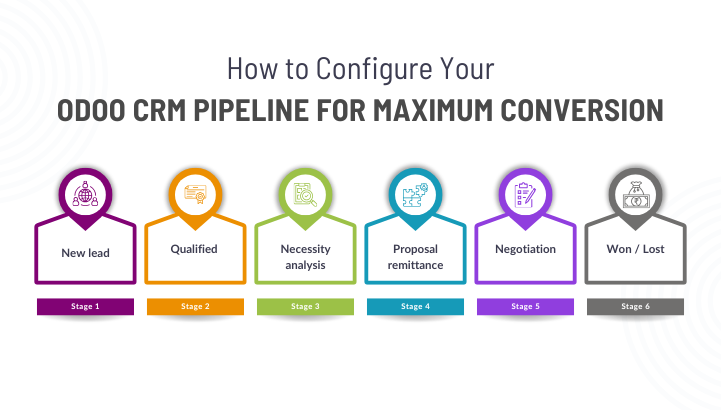
Recommended Pipeline Stages:
With this structure in place, your pipeline data becomes trustworthy, and trustworthy data is the foundation of every other improvement you’ll make.
Not every lead deserves equal attention, and in CRM software Australia businesses, you have the tools to make that call automatically. Odoo’s built-in lead scoring feature lets you assign probability scores based on activity, source, and stage history.
Here’s how to set up a simple but effective scoring model. In Odoo CRM settings, enable the ‘Predictive Lead Scoring’ feature. This uses machine learning trained on your historical data to assign win-probability percentages to each opportunity. The more closed deals you have logged (won and lost), the smarter it gets.
For B2B services companies, a practical manual scoring approach works just as well early on. Score leads on three criteria: fit (does their company profile match your ICP?), need (have they expressed a specific problem you solve?), and timing (do they have a decision timeline?). Use Odoo’s custom fields to log a score of 1–3 for each. Any lead scoring 7 or above gets a same-day follow-up. Below 5 goes into a nurture sequence.
Prioritisation isn’t just about efficiency, it’s about revenue. Salespeople who focus on high-score leads close at roughly double the rate of those working undifferentiated lists.
Our team specialises in Odoo CRM implementations for manufacturing, distribution, retail, and services companies. Envertis helps Australian businesses deploy Odoo CRM solutions that are built to sell – not just store contacts. We’ll map your sales process, configure your pipeline, and train your team.

The average salesperson follows up only 1.3 times before giving up, but 80% of sales require five or more touchpoints. Odoo CRM’s automated action and activity scheduling features exist precisely to bridge this gap.
Inside Odoo, go to CRM > Configuration > Automated Actions. Create a rule that triggers when an opportunity has been in the ‘Proposal Sent’ stage for more than 3 days with no activity logged. The action: automatically schedule a follow-up call for the responsible salesperson. They get a reminder, the lead doesn’t go cold, and nothing falls through the cracks.
For retail and ecommerce businesses, the same logic applies to web leads. Set up an automated email sequence using Odoo’s Email Marketing integration, triggered the moment a lead is created from your website form. A three-touch sequence (immediate reply, value email at day 2, soft CTA at day 5) can double your lead-to-call conversion rate without adding any manual workload.
Collaborating with an Odoo CRM Australia implementation partner is not about removing the human element. It’s about ensuring the human element shows up consistently and at the right time.
Most sales managers use CRM reports to review what happened. The best ones use them to predict what will happen and intervene before deals go cold. Odoo CRM’s reporting module gives you everything you need if you know which numbers to watch.
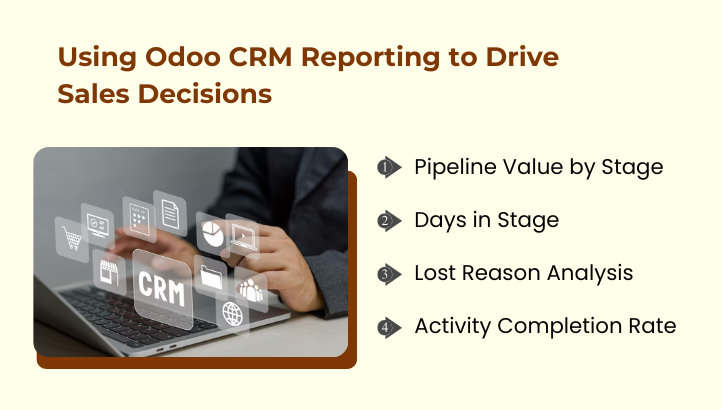
The four metrics that matter most:
Build a weekly dashboard in Odoo using these four metrics and review it in your Monday sales meeting. Decisions made with this data will consistently outperform gut-feel sales management.
Odoo CRM’s biggest advantage over standalone CRM tools is that it lives inside a fully integrated business platform. When your CRM connects directly to your inventory, invoicing, and helpdesk, you close the loop between sales and operations, and that’s where serious ROI is found.
For manufacturing and distribution companies, this integration is transformative. When a sales rep closes a deal in Odoo CRM, the confirmed sale automatically generates a purchase order, triggers an inventory check, and creates a delivery order, without a single handoff email or data re-entry. In practice, this eliminates between 3 and 6 hours of administrative work per deal.
For service companies, connecting Odoo CRM deployment with Envertis to the Project module means that when a deal is won, a project is created automatically with the scope, responsible team member, and deadline pre-populated from the CRM opportunity. Your operations team starts work the same day the deal closes.
If you’re using Odoo CRM as a standalone module and not connecting it to your other business processes, you’re getting roughly 40% of the value it’s capable of delivering.

Technology doesn’t close deals, people do. And even the best-configured Odoo CRM will deliver zero ROI if your sales team treats it as optional. Adoption is a leadership challenge, not a training challenge.
The most effective approach is to make Odoo CRM the only place sales conversations happen. If a deal isn’t in the CRM, it doesn’t count toward quota. If an activity isn’t logged, the meeting didn’t happen. This sounds harsh, but it creates a data environment you can actually manage from.
Practically, that means running every sales meeting from the Odoo pipeline view. When your Monday review is a live walk through open opportunities in Odoo, not a verbal update, the system becomes part of the team’s workflow rather than a reporting afterthought. Teams that do this see adoption rates above 90% within 60 days.
The goal is to make using Odoo CRM the path of least resistance for your team, not an additional burden. When the system helps them sell better, they’ll use it without being asked.
Odoo CRM is one of the most capable and cost-effective sales platforms available for growing businesses. But capability doesn’t equal results. Results come from deliberate configuration, intelligent automation, disciplined reporting, and genuine team adoption.
The businesses seeing the highest return from Odoo CRM, whether they’re running manufacturing operations, managing a distribution network, scaling an ecommerce brand, or delivering professional services, all have one thing in common: they treat the CRM as a living system that reflects and drives their sales process, not a database that records it after the fact.
Start with your pipeline. Get the stages right. Add scoring. Automate follow-ups. Connect your modules. And lead from the data every single week.
Envertis designs and deploys Odoo CRM solutions that fit the sales team’s requirements with businesses in manufacturing, distribution, retail, and services to design CRM systems that drive measurable sales outcomes, not just software deployments.

Get free consultation and let us know your project idea to turn it into an amazing digital product.

Se 506, 8 Help Street, Chatswood, NSW 2067
324 Queen Street, Brisbane, QLD 4000
171 Collins Street, Melbourne, VIC 3000