
Discover how Odoo Australia provides businesses with powerful solutions to help them streamline performance, drive

Discover how Odoo Australia provides businesses with powerful solutions to help them streamline performance, drive productivity, and scale up for the future. Odoo enables Australian SMEs to reconfigure for growth using the right ERP strategy.
Businesses in Australia today require speed, accuracy, and smarter technology. Odoo empowers local businesses with an ERP platform that integrates all departments, automates management processes, and improves decision-making. Retail, manufacturing, distribution, and services are all adopting Odoo Australia quickly to replace siloed systems with faster ways of working. Businesses that do not adopt the modernisation strategy run the risk of being put out of business by competitors that are leading the way to transform their operations.
In this blog, we will highlight how Odoo Australia can help local businesses build technology for the future, outline the key modules of the Odoo system and explain the structured implementation process.
Why Australian Businesses Need an Integrated ERP Solution
The digital economy is reshaping how companies operate and engage with customers. Many Australian SMEs are still using outdated systems or manual practices that limit growth, data accuracy, and reliability. Odoo in Australia offers a solution that incorporates flexibility, simplicity, and scalability all in one platform.
In modern organisations, there is the expectation of a centralised ERP to manage finance, sales, inventory, and human resources, all without having to switch from one platform to another. Odoo Australia addresses this challenge with a modern modular approach that allows a business to digitise piece by piece, with focus on the areas of highest impact to start with.
When introduced in a strategic way, an ERP can reduce the time spent on repetitive activities, improve collaboration throughout the organisation, and ultimately support faster growth. The Australian community now sees that the value of investing in Odoo Australia is no longer focusing on just the technology; it is becoming about ensuring ongoing competitiveness into the future.
Understanding Odoo Australia and Its Value
Odoo Australia is a comprehensive suite of open-source business applications that fulfil several specific operational and local compliance requirements. The entire platform is designed to integrate seamlessly with a variety of Australian accounting standards, GST regulations, and business processes, ensuring companies do not need to manually adjust processes or risk making an error.
Unlike rigid legacy systems, Odoo in Australia is highly customisable. Companies can start small with key modules such as Sales or Inventory, and then gradually introduce more sophisticated functionalities like Manufacturing or CRM. This guarantees that businesses only invest in what they need while enabling future expansion.
The Australian business landscape values flexibility. With Odoo’s unique modular approach, SMEs can future-proof their operations and scale easily without requiring significant upgrades. Whether a business wants better data reporting, enhanced communication, or more visibility in processes, Odoo Australia offers the right balance of simplicity and sophistication.
Key Modules that Drive Business Efficiency
Every Odoo module works together to create a fully connected digital ecosystem, allowing every activity to be linked through an integrated database. Appreciating how to use these modules will enable SMEs to see where the greatest improvement can be achieved.
Odoo Australia has a comprehensive range of applications that cater to the requirements of Australian businesses to stay compliant and competitive.
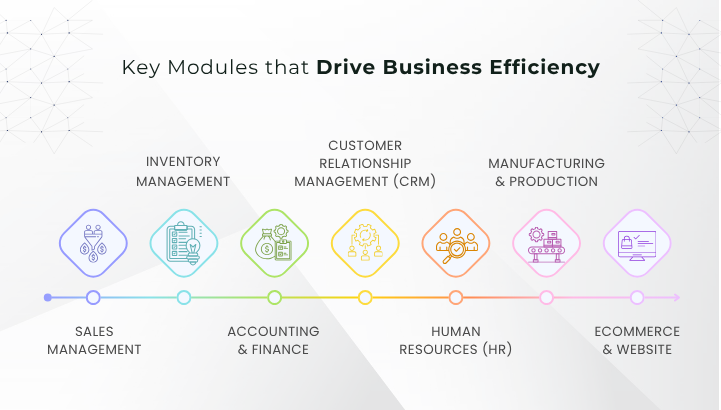
It enables Australian businesses to manage quotations, contracts, and customer relationships within a body of knowledge that is accurate and traceable.
An example is a logistics provider based in Melbourne that can maintain a digital record of quotes and customer agreements in line with the Australian Consumer Law (ACL). Automated workflows deliver consistent pricing, accurate tax calculations, and compliant documentation under the requirements expected of an Australian business transaction.
The Inventory Management Module in Odoo Australia ensures that stock is handled effectively, integrating traceability features compliant with Australian import–export documentation and warehouse safety standards.
For example, a food distributor based in Sydney can implement serial number tracking that complies with the Australian Border Force (ABF) reporting and record data to support the Chain of Responsibility (CoR). Module integrations to barcode scanning and warehouse routing reduce risk and deliver operational audits smoothly.
For organisations using Odoo in Australia, Accounting and Finance is one of the most compliance-focused modules. This module is specifically mapped to the Australian Accounting Standards Board (AASB) and also includes reporting requirements of the Australian Taxation Office (ATO) and Goods and Services Tax (GST) regulations.
As an example, a financial services business in Brisbane can run BAS (Business Activity Statements), payroll tax calculations, and STP (Single Touch Payroll) submissions automatically to support compliance with local taxation regulations, financial transparency, and auditability.
It centralises all engagements with clients with regard to Australian Privacy Principles (APPs) in the Australian Privacy Act 1988. The CRM module can also manage consents for electronic communications and marketing consent, preserving integrity in virtual engagements and confirming protections for customers’ rights.
Such as a professional services business in Perth can collect, store, and manage customer data securely, monitoring compliance with data protection and consents.
The HR aspect is geared to manage Australian workplace compliance frameworks with the Fair Work Act 2009 and National Employment Standards (NES). The HR module also caters for digital record keeping in line with Australian Taxation Office (ATO) requirements for employee data and superannuation contributions.
A retail business in Adelaide can use this module to replace the payroll system under correct award rates, manage leave entitlements, and track hours worked.
It ensures production operations achieve the relevant Australian industry standards for related operations such as quality control, workplace safety, and environmental compliance. Also, automated tracking and traceability enable you to track the raw materials used to produce your product, and ensure compliance with Australian labelling and export documentation.
A manufacturer in Queensland could have a quality-checking process in place, for instance, aligned with ISO 9001 standards, or local WHS (Work Health and Safety) standards.
These modules conform to Australian laws for online trading workflow and consumer protection rights. Additionally, the system provides Payment Card Industry Data Security Standard (PCI DSS) compliance for online payments and protection of customer data under Australian privacy legislation.
For example, a furniture seller in Sydney can establish an online shop that shows prices inclusive of Goods and Services Tax (GST), has clear refund policies, and promotes the terms in alignment with the Australian Consumer Law (ACL).
Together, these modules enable local businesses to operate with assurance within regulatory frameworks in Australia while improving operational efficiency. Deploying Odoo in Australia assists organisations with compliance requirements automatically, decreases administrative burdens, and provides complete transparency across each department.
By using compliance built directly into the workflows, Odoo Australia streamlines the day-to-day management of the business, while also providing greater assurance in relation to audit readiness, enforcement inspections, and future scalability for growth. As a result, business owners can be confident that the small to medium-sized enterprises are acting responsibly, efficiently, and fully compliant with Australian business standards — ultimately supporting their growth with confidence within a regulated marketplace.
Odoo Australia Roadmap: Step-by-step Implementation Guide
To successfully roll out Odoo in Australia, it requires planning and an understanding of business goals. The process can be boiled down into multiple practical steps, which contribute to seamless adoption and measurable outcomes.
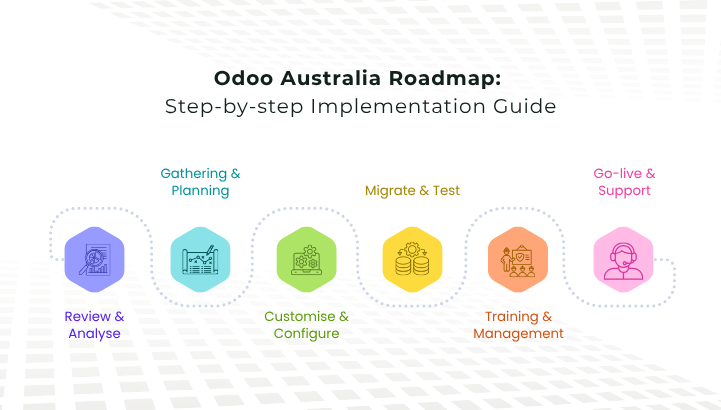
All journeys start with defining the challenges and inefficiencies of existing systems. Businesses must undertake an exercise to map and review existing workflows and operational gaps. At this stage, the business decides which modules of Odoo Australia will help deliver immediate value.
Define outcomes, deadlines, and customisation requirements. As an SME in Australia, it’s important to focus on a fit of Odoo’s capabilities with your strategic objectives to measure success.
It is crucial to pick an experienced Odoo implementation partner in Australia. They can ensure your organisation’s operations are compliant with Australian financial governance, data protection, and ethical practices. Expert consultants can help navigate marketplace challenges in their local considerations with Odoo ERP systems.
Selecting modules is only the first part of the process. The next step is to change them to suit your industry requirements. This may include changing workflow, a custom dashboard, or integrating third-party tools to ensure the ERP fits with day-to-day business approaches.
It is imperative to move accurate data from legacy systems. So, it is crucial to test all modules to verify that all integrations are functioning properly while reducing any potential impacts to business continuity. This step aims to ensure the live environment operates fully and efficiently on day one.
A system is only effective when the people using the system are effective. Extensive training sessions are established to have all employees understand the functionalities, feel comfortable in their use, and maximise the system’s ability to meet business processes. Being positive in change management will push user adoption throughout the functional departments.
After everything has been implemented, the system is in a live state. However, it is important to monitor and adjust as needed. Providing regular feedback, ongoing updates, and integrating new modules will ensure the coordination of Odoo in Australia with the developing business strategies. Continuous improvement of the system will support the ERP process transitioning to a positive long-term strategic advantage.
By structuring these activities, it should be understood that every phase of the implementation process creates measurable business value, supporting Australian SMEs in their drive for ongoing success.
Choosing which edition of Odoo to go with is a balancing act between ease of use and control. Each edition of Odoo Australia has different degrees of flexibility, scalability, and management responsibility. Self-managed or PaaS editions of Odoo might be more ideal for businesses needing full customisation control. In contrast, SaaS will generally appeal to businesses that value ease of use and fast implementations.
The overview below provides objective comparisons of Odoo editions by considering hosting, costs, and functionalities to help Australian businesses understand the principles behind the different editions.
Get free consultation and let us know your project idea to turn it into an amazing digital product.

Se 506, 8 Help Street, Chatswood, NSW 2067
324 Queen Street, Brisbane, QLD 4000
171 Collins Street, Melbourne, VIC 3000