
Do you know the ERP industry is expected to grow at a compound annual growth rate (CAGR) of 7.1% by 2034? It sums to

Do you know the ERP industry is expected to grow at a compound annual growth rate (CAGR) of 7.1% by 2034? It sums to nearly $110.15 billion. (Source: The CFO Club).
The shift is rapidly evolving how small and medium-sized businesses operate across the globe, including Australia. In a highly competitive marketplace, as large enterprises implement innovative technologies to streamline operations, ERP for startups in Australia is a must-have.
There is an accelerating demand for transparent, sophisticated, and automated, all-in-one platforms that provide access to real-time data and multi-location visibility, enabling faster, informed decision-making.
This guide is designed for early-stage and fast-scaling startups across Australia. It breaks down what ERP looks like in a startup environment, highlights key operational indicators that signal when to adopt ERP, and evaluates six ERP platforms commonly considered in the Australian market.
The focus is on enabling compliance, supporting sustainable growth, and delivering investor-ready reporting, without the burden of complex enterprise systems.
In simple terms, ERP stands for Enterprise Resource Planning: a unified platform that integrates multiple business operations, such as sales, inventory, finance, accounting, and reporting, to reduce errors, eliminate risks, and accelerate speed-to-market.
So, ERP for startups imply ERP adoption by growing companies that intend to scale smoothly and effectively. When scaling businesses in Australia compete with large enterprises, they require lean teams, cloud deployment, and lower operational costs to enhance flexibility and improve the customer experience.
Thus, ERP for startups in Australia take over fragmented systems and reduces data silos that involve:
Thus, growth follows effortlessly, and new companies gain better control over their sustained performance.
Many startups begin using database and spreadsheet applications as their primary tools for managing daily operations. While this methodology is appropriate during the early stages of a startup, as a company’s operations expand, it becomes increasingly ineffective.
Therefore, implementing ERP at the appropriate time is an essential component for creating more efficient processes, increasing visibility into the business’s daily operations, and supporting scalable growth.
Recognising ERP readiness indicators will help avoid operational bottlenecks and inefficiencies, and prevent them from persisting over an extended period.
If different teams use different tools to manage sales, finance, inventory, and HR, then the data for these departments will be fragmented. ERP for startups in Australia will provide the means to centralise data, enabling increased collaboration.
Entering information on multiple occasions, using numerous spreadsheets, and reconciling information manually create more opportunities for errors and make the process take longer. An ERP will minimise the work required by automating processes, thereby increasing accuracy.
For a company to expand its customer base, product lines, or service offerings, it will require increased process control and an efficient method to grow without becoming chaotic. ERP systems allow a company to expand without creating operational chaos.
If a company cannot accurately monitor its cash flow and expenses or produce timely financial reports, it may need to establish a single financial system via an ERP.
A business cannot make informed decisions if the information available at the time of decision-making is outdated or inconsistent. ERP for startups provide real-time dashboards and actionable data to management teams.
Delayed order processing, inventory mismatches, and inconsistent service are common problems that occur when a business’s systems are disconnected. ERP will improve the speed and accuracy of the order-to-delivery process.
Startups need to abide by more regulatory and audit requirements as they grow and develop. An ERP will facilitate compliance by providing standardised workflows and accurate reporting.
| Triggers | Why ERP Helps | Impact |
| Manual overload | Centralises operations in one system | Saves time, reduces errors, improves efficiency |
| Inventory complexity | Real-time inventory management and demand forecasting | Reduces costs, improves order fulfilment, and increases customer satisfaction |
| Financial management stress | Automates financial processes and generates reports | Enhances decision-making, ensures compliance, simplifies audits |
| Customer service issues | Integrates CRM with sales and support | Improves customer experience, loyalty, and retention |
| Compliance and regulatory needs | Provides audit-ready records and compliance tracking | Reduces risk of fines and legal issues |
| High operational costs | Streamlines workflows and automates repetitive tasks | Reduces operational costs significantly |
| Decision-making challenges | Provides dashboards and analytics | Enables informed, data-driven strategic decisions |
| Multiple location handling | Provides a unified view across locations | Better visibility, consistent operations, streamlined reporting |
| Fast scaling | Scales operations without chaos | Maintains productivity and supports smooth expansion |
A startup should implement an ERP when growth starts to stress existing systems, not based on the company’s age. Early, modular adoption allows startups to stay agile, reduce risks, and build a strong foundation for sustainable expansion.
Cloud technology is the new norm, and ERP is not an exception. According to a study by Blue Link ERP, 76% of businesses have started or already shifted their on-premises ERP to the Cloud.
Thus, ERP for startups in Australia is largely cloud-based. However, based on ERP architectures, there are three distinct models which are explained below:
Open-source ERP, also known as modular ERP, is generally preferred for its flexibility and customisation capabilities. Typically, you can control the cost and scope of your business. Therefore, it results in incremental growth. You have a clear, uncomplicated system that leads to long-term success.
It is not necessary to adopt all the ERP modules. Growing companies with a limited budget often consider a finance-focused ERP for compliance, accounting, and financial reporting. You have increased financial visibility and control.
Enterprise ERP is a fully integrated system that enables organisations to manage complex operations from a centralised platform. Enterprise ERP for startups is ideal for rapid growth and expansion across multiple markets. However, early-stage companies may find enterprise ERP more costly and less flexible than modular approaches.
The Australian marketplace is growing rapidly, and to adapt to shifting needs, ERP for startups in Australia has become imperative; most businesses implement it earlier in their business cycles.
The ERP platforms outlined below represent common evaluation choices among Australian startups, informed by company maturity, operational complexity, and required functional coverage. These solutions are categorised by adoption patterns and functional scope rather than ranked by pricing, performance, or overall suitability.
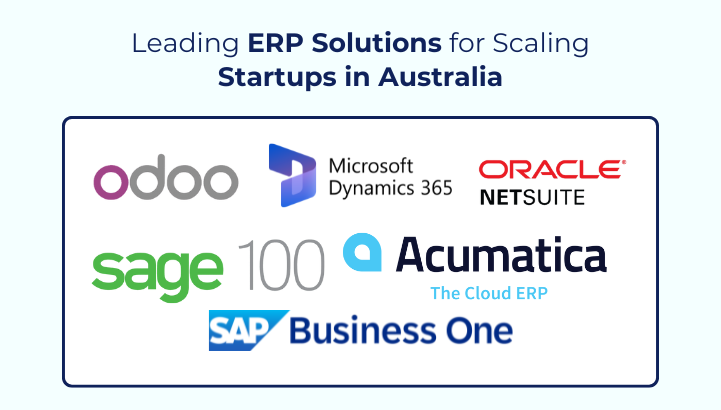
Odoo is a fully integrated ERP for small businesses with multiple departments, such as logistics, distribution, and manufacturing, that helps startups consolidate their core business functions into a single, connected solution in one location, enabling them to work together as a single unit.
Odoo, as an ERP for startups, eliminates the need for spreadsheets and disconnected tools, enabling significant efficiencies, including automation of workflows and deeper insight into the company’s overall operations.
Fundamental Strengths:
Use Cases:
Generally, Odoo is preferred by e-commerce brands that need inventory-to-sales workflows, service startups that manage projects and billing, and small manufacturers that track stock and orders.
Pricing Structure:
The total cost of Odoo implementation depends significantly on the scope of customisation and the hosting model.
Microsoft Dynamics 365 provides a cloud-based suite of enterprise services that help organisations manage core business processes across sales, service, finance, operations, and HR in a single, unified environment.
This software integrates ERP and CRM functionality into a single product, enabling companies to optimise process flows, increase employee efficiency, and leverage actionable insights from real-time data to make better business decisions.
Fundamental Strengths:
Use Cases:
Particularly, Microsoft Dynamics 365 is used by wholesale, enterprise, and multi-entity services.
Pricing Structure:
As an ERP for startups in Australia, the subscription cost is mid-range, with a single user per authorisation.
SAP Business One is an ERP solution developed for small and medium-sized enterprises (SMEs). In contrast, other SAP products for larger enterprises, such as the SAP S/4HANA product family, offer greater complexity, higher price points, and more functionality.
Fundamental Strengths:
Use Cases:
Growing manufacturing, supply chain, and logistics companies adopt SAP Business One later in their growth to leverage its integrated capabilities.
Pricing Structure:
Compared to other ERPs for startups in Australia, it has a higher upfront cost.
NetSuite, an ERP for startups in Australia, is designed to help small and growing businesses manage their operations by allowing you to do all of your core business functions, such as finance management, inventory management, customer relationship management, e-commerce, etc., from just one system instead of multiple on-premises ERP systems.
It makes your company more agile as it grows. Because NetSuite is built in the cloud, there are no complex hardware or networking requirements for setting up or maintaining the platform. Therefore, a startup can scale and adapt quickly in line with its empirical growth while remaining fully accessible from any location with an internet connection.
Fundamental Strengths:
Use Cases:
NetSuite is extensively preferred by rapidly growing startups that require complex compliance requirements and reporting.
Pricing Structure:
It accompanies high implementation investment.
Sage Intacct is a cloud-based financial management and accounting platform. This application was developed to help growing businesses manage their finances, scale their operations and provide accurate financial reporting through an easier-to-use platform than a traditional ERP.
Startups that require greater financial accountability in their early stages will benefit from this product.
Fundamental Benefits:
Use Cases:
Startups backed by VC that require complex reporting use Sage Intacct.
Pricing Structure:
For early-stage scaling organisations, it is a heavy financial investment.
Acumatica is a cloud-based ERP for startups seeking a single, scalable solution to manage finance, CRM, inventory, project management, and operations. Its scalable architecture enables businesses to scale over time without incurring the high costs of replacing systems.
Acumatica enables start-ups to design and implement their own processes, adapt them to changing needs over time, and integrate easily with the many other SaaS applications and eCommerce platforms used by rapidly growing businesses.
Fundamental Benefits:
Use Cases:
Acumatica is ideal for growing organisations with multi-entity existence and increasing transaction volumes.
Pricing Structure:
The cost varies based on software usage.
ERP adoption is easier than developing custom software. With greater control over business processes, real-time visibility, and structured reporting, ERP for startups in Australia is a sound investment.
Automating business operations helps growing companies focus on other significant tasks that require precise attention and expertise. Additionally, ERP software helps minimise manual errors and increase speed-to-market. Therefore, startups that adapt ERP early gain a competitive advantage and achieve results faster.
Envertis is a highly recognised Australian company delivering exceptional customised Odoo solutions to small and medium-sized businesses. With a team of extensively skilled Odoo-certified experts, Envertis help scaling organisations grow without bottlenecks and achieve tangible outcomes.

Startups need an ERP (Enterprise Resource Planning) system because it provides a centralised platform to manage core business processes efficiently, reduce errors, and support growth. Additionally, an ERP offers greater flexibility and stability, providing a competitive edge.
The pricing structure for ERP for startups in Australia varies significantly depending on the model, complexity, and number of users. The upfront cost of cloud-native ERP is low, and modular models help startups control their investments at every stage.
No. ERP can scale with your business. When selected and implemented appropriately, ERP can grow with your business by adding new modules that fit your needs.
Get free consultation and let us know your project idea to turn it into an amazing digital product.

Se 506, 8 Help Street, Chatswood, NSW 2067
324 Queen Street, Brisbane, QLD 4000
171 Collins Street, Melbourne, VIC 3000